The Tianyun Report: China’s Premier Fish Farm in Xinjiang
In April 2026, the Outlaw Ocean Project testified before Congress about our upcoming “Food for Feed” investigation that examines the global fishmeal and aquaculture industries. The testimony primarily focused on China’s role, including how Xinjiang is among the fastest-growing segments of the country’s fish farming industry and the exposure of the US to seafood coming from Xinjiang in violation of federal law.
During the testimony, we discussed a company called Xinjiang Tianyun Organic Agriculture. In the subsequent months, we provided further reporting on Tianyun to several Congressional offices and various US government agencies, including the Departments of State, Labor and Homeland Security.
Tianyun is important because it claims to be China’s biggest producer of farmed salmon. It has also become the poster child of China’s so-called Blue Miracle, or the country’s burgeoning aquaculture industry in Xinjiang. In the US context, Tianyun is significant because, through a series of intermediaries, it has supplied the world’s largest food service company, Sysco, which distributes to US public schools, federal prisons, military bases, and Congressional cafeterias.
Food for Feed’s new revelations about forced labor within Chinese aquaculture at Tianyun and a thousand other Xinjiang fish farms build on a 2023 Outlaw Ocean investigation that revealed state-sponsored forced labor on ships and in processing plants in China, particularly in the form of North Korean and Uyghur workers.
Under US law, all products from Xinjiang are banned and considered to be tied to state-sponsored forced labor because of the pervasiveness and intensity of repression in that region. One of the largest exporters of seafood to the US is China but many American companies struggle to trace or police their supply chains in China because unannounced spot checks are impossible, press and civil society is tightly controlled and raising human rights concerns or touching on the topic of Xinjiang can lead to arrest or expulsion.
In August 2026, the Department of Homeland Security added Xinjiang Tianyun to the Entity List of banned companies under the Uyghur Forced Labor Prevention Act (UFLPA). The company was listed for “sourcing material” from Xinjiang or “cooperating with the local government or the Xinjiang Production and Construction Corps (XPCC) on ‘poverty alleviation’ or ‘pairing assistance’ labor programs,” according to the Department of Homeland Security.
The following is the detailed reporting on this company that contributed to that UFLPA listing.
Key Takeaways
- In August 2026, Xinjiang Tianyun was added to the UFLPA Entity List by the US Department of Homeland Security. The company was listed for “sourcing material from the XUAR or cooperating with the local government or the Xinjiang Production and Construction Corps (XPCC) on ‘poverty alleviation’ or ‘pairing assistance’ labor programs,” according to the Department of Homeland Security.
- The poster child of the Blue Miracle initiative, China's campaign to build aquaculture in its arid western regions, Xinjiang Tianyun claims to produce approximately 40 percent of the country’s salmon. In 2024, Tianyun expected to produce 7,700 tons of rainbow trout, with an expected export value of 50 million yuan, according to an article by the Xinjiang Department of Agriculture and Rural Affairs.
- Tianyun exports to over a dozen countries, including Thailand, Singapore, Malaysia, Japan, Russia, Spain, the United Kingdom, and Germany. Tianyun primarily exports through its cold-storage and logistics subsidiary, named Shanghai Shanhaiji Supply Chain.
- In 2022, Xinjiang Tianyun signed an agreement to sell $140 million worth of salmon to Dalian Rich Enterprise Group Co Ltd. Dalian Rich sells frozen salmon to seafood processing companies in the US, Canada, and Europe under various brands. Customers of Dalian Rich included North American companies like Aqua Star between 2022 and 2023. Aqua Star supplies the foodservice sector in the United States, including farmed salmon products to the likes of Sysco.1
- Sysco's distribution of this seafood is significant because as the world’s largest food-service corporation, it supplies public schools, federal prisons, military bases, and Congressional cafeterias.
- Xinjiang is now among the fastest-growing aquaculture regions in China, with production expanding by roughly 85 percent in dollar value since 2017. The initiative is often referred to as the “Blue Miracle.” Salmon has emerged as one of Xinjiang’s most prized seafoods. In 2022, Xinjiang fish farms produced more than 4,500 tons of salmon, accounting for 15 percent of the country’s total salmon output from the nation’s inland regions. By 2024, Xinjiang’s production had increased to over 8,000 tons, according to Xinjiang Daily.2
- Tianyun has also talked about its work in the context of food security and national security. In 2023, Tianyun posted to its WeChat account a statement by the Ministry of Agriculture and Rural Affairs that emphasized agriculture as a foundation for national security.3 “A country must be supported by strong agriculture if it wants to be truly strong,” the statement said. Developing the industry, especially through science and technology, will enable the nation to “take the autonomy of development into our own hands.”
Summary
The Food-for-Feed investigation by The Outlaw Ocean Project has uncovered the rapid expansion of aquaculture production in Xinjiang. The investigation found that Xinjiang is now among the fastest-growing aquaculture regions in China, with production expanding by roughly 85 percent in dollar value since 2017, when the government’s western aquaculture campaign intensified.4 The initiative, often referred to as the “Blue Miracle,” promotes aquaculture in a region that is largely arid, saline, and thousands of miles from the ocean.
China’s inland push of fish farming is not just for food production. It is also part of a larger government campaign aimed at pacifying and modernizing the country’s restive and poorer western regions, including Xinjiang and Tibet. The aquaculture industry is being used to convert nomadic herders into sedentary farmers.
The effort also aims to decrease the environmental pollution off China’s eastern coast, where offshore fish farming was overly concentrated in decades past, and to strengthen the country’s food independence by lessening the burden on the high-seas fishing fleet. Nationally, fish farms in China now produce over four times the amount of catch that its fishing vessels do.
The fish farming campaign is also a source of national pride, bolstered by a government-backed media campaign that highlights the engineering ingenuity that has been required to achieve aquaculture in such an inhospitable location. The Chinese government did not respond to a request for comment.5
Salmon has emerged as one of Xinjiang’s most prized seafoods. In 2022, Xinjiang fish farms produced more than 4,500 tons of salmon, accounting for 15 percent of the country’s total salmon output from the nation’s inland regions.6 This figure rose to more than 6,700 tons of salmon in 2023.7 Xinjiang's salmon production accounts for thirty percent of China’s total salmon production, a Chinese Academy of Fishery Sciences director said in 2024.8 That year, Xinjiang’s production jumped by roughly 20 percent, increasing from about 6,700 tons to over 8,000 tons, according to Xinjiang Daily.9
“Xinjiang is expected to become the country’s largest production and supply base for high-quality salmon around 2026,” said officials from Xinjiang’s Agricultural and Rural Affairs Department in a piece reported by Chao News.10 “Desert seafood” is being sold across China and around the world, reported a 2025 article by CCTV, China’s national news network.11 “Raising fish in the desert? It sounds impossible, but in Xinjiang, it’s becoming a reality.” More than 1,000 farms are spread across three inland regions: Xinjiang, Tibet, and Qinghai.12
Xinjiang and Tibet produce an estimated half a billion dollars’ worth of farmed seafood annually, much of which is exported to more than a dozen countries, including the United States, Canada, and Russia, as well as markets across Europe. The poster child of this initiative is the Xinjiang-based company, Xinjiang Tianyun Organic Agriculture, which claims to produce approximately 40 percent of China’s salmon. Some of this seafood enters the US in violation of federal law. Through intermediaries, Tianyun supplied seafood to Aqua Star that was then distributed to Congressional cafeterias, public schools, federal prisons, and military bases by Sysco, the world’s largest food-service company.
Xinjiang Tianyun Organic Agriculture
Xinjiang Tianyun Organic Agriculture Co., Ltd. is an aquaculture company based in Ili Prefecture, Xinjiang, China. Tianyun is one of the largest Chinese companies raising trout in the inland regions of Qinghai, Gansu, and Xinjiang.13 The company was established on February 24, 2014, and its business includes sales of prepackaged food, investment, and development.14
Tianyun produces more than six thousand metric tons of fish per year and has a registered capital of 262.18 million yuan, about $36 million, according to a 2021 article in Seafood Source.15 In 2024, Tianyun expected to produce 7,700 tons of rainbow trout, with an expected export value of 50 million yuan, according to an article by the Xinjiang Department of Agriculture and Rural Affairs.16 At the eighth China-Eurasia Expo in 2024, Zhang Yuru, deputy general manager of Xinjiang Tianyun Organic Agriculture, said the company had also launched “salmon collagen peptide drinks and salmon peptide tablets,” according to Tianshan Net.17 These protein supplements are marketed as anti-aging treatments to help skin and joints remain supple, though the supporting evidence on their efficacy remains sparse.18
7,700 tons of rainbow trout were produced by Tianyun in 2024, with an expected export value of 50 million yuan.
Tianyun has claimed to hold multiple certifications, “including the Global Aquaculture Alliance BAP, Global Food Safety BRC Certification, Antibiotic-free Product Certification, China Quality Certification Center HACCP System and Good Agricultural Practice Certification (Level 1),” a 2023 article by Seafood Guide said.19 Best Aquaculture Practices, or BAP, is a certification program run by the Global Seafood Alliance, an industry-led trade group based in the United States. BAP certification purports to verify that producers meet standards for environmental sustainability, food safety, and labor practices.
“Our company uses the BAP standard management process, combined with digital traceability, to guarantee traceability from source to consumer,” Susan Zhang, a general manager at Shanghai Shanhaiji Supply Chain, a Tianyun affiliate, said at Seafood Expo Asia in 2023. Her division produces about 15,000 metric tons of BAP-certified salmon annually in Xinjiang’s Tianshan Mountains, she said. “In China,” Zhang added, “BAP certification is a strong symbol of food safety.”
In 2024, the Aquaculture Stewardship Council announced that it would withdraw from China. Industry press tied the decision to the revelations about forced labor but ASC said that it was solely made based on financial reasons for its decision.20 By contrast, BAP has remained active in the country.
In August 2026, Xinjiang Tianyun was added to the Uyghur Forced Labor Prevention Act Entity List by the US Department of Homeland Security. The company was listed because it is suspected of sourcing “salmon from salmon farms” in Xinjiang and participates in Xinjiang government-sponsored “recruitment and labor transfer programs to recruit, transfer, and receive Uyghur, Kazakh, and/or Kyrgyz persons” out of Xinjiang, according to the Department of Homeland Security.21
Tianyun said in a statement that claims of systemic forced labor “are completely factually unfounded” and described the Uyghur Forced Labor Prevention Act (UFLPA) as an unreasonable and politically motivated framework which violates the principles of fair international trade.22 Tianyun strictly abides by China’s laws on labor and contracts and resolutely protects the legitimate rights and interests of every employee. “Our company has never been involved in, nor will it ever participate in, any form of forced labor,” Tianyun said. “On the contrary, we provide competitive compensation, comprehensive occupational health and safety protections, and career development opportunities.”23 The XPCC did not respond to a request for comment.24
Ownership & Subsidiaries
On May 13, 2025, Anhui Lingtong Group Holding Co., Ltd.25 signed an agreement to become the second largest shareholder of Tianyun, according to a WeChat post by Anhui Lingtong Group.26 Anhui Lingtong Group is a corporation with subsidiaries in energy, transportation and logistics.27 One of its subsidiaries is Anhui Lingtong Logistics Co., Ltd., established in 2008. In its early days, this logistics company worked to “support the construction of western Xinjiang,” with “bulk coal logistics as its core business,” according to a 2023 article by Chinese media outlet The Paper.28 Through the agreement with Tianyun, “we will strive to make every salmon that jumps out of the water carry the mission of frontier revitalization and green economy, and write a new chapter in the high-quality development of China's modern agriculture,” wrote Anhui Lingtong Group’s WeChat post.29
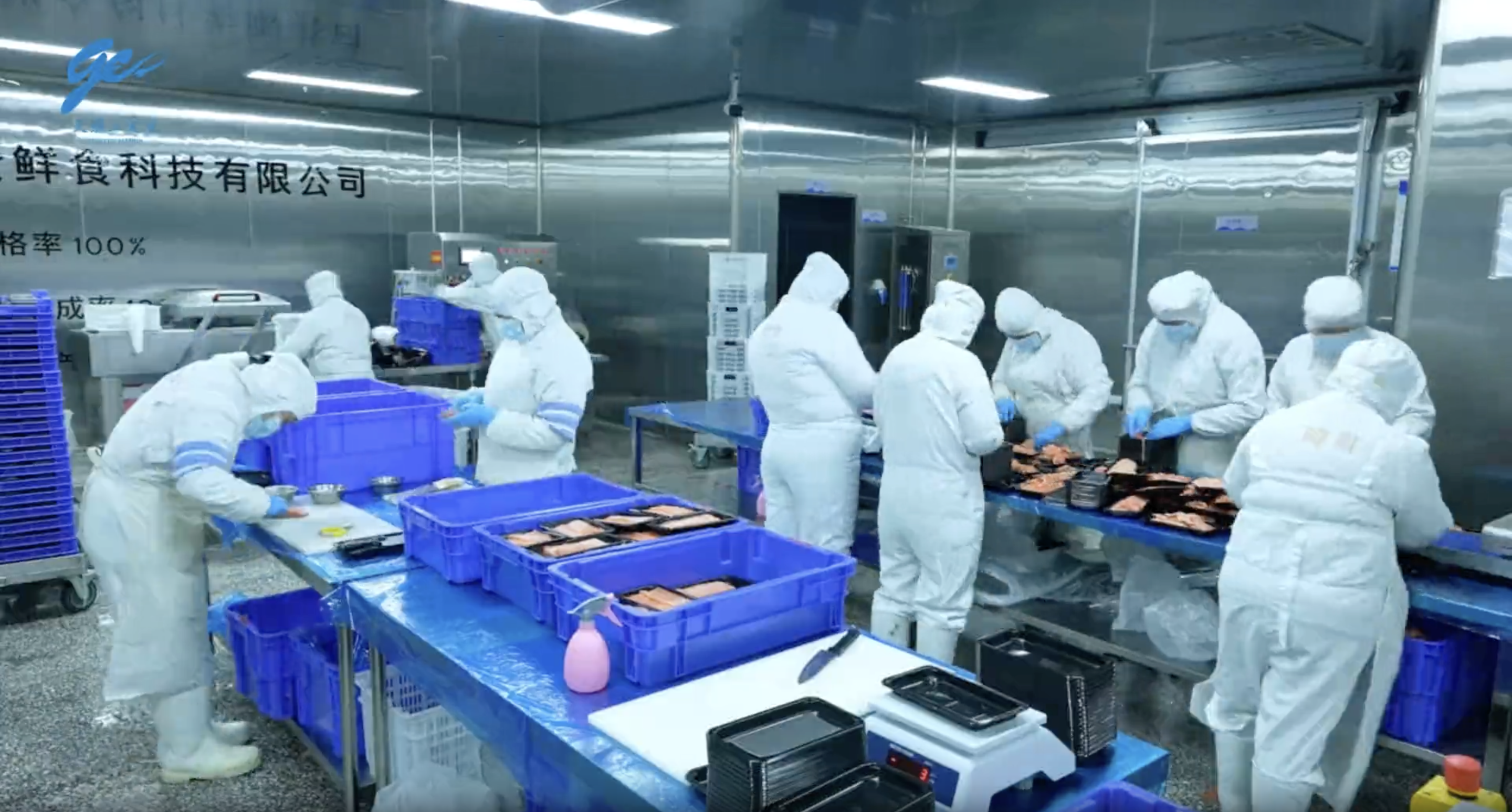
Xinjiang Tianyun's broader operations, including its various subsidiaries, comprise: the company’s corporate headquarters and a salmon breeding and cultivation site named Xinjiang Tianyun Organic Agriculture Co., Ltd.; three fish farms named: Tekes County Tianyun Fishery Co., Ltd., Gongliu County Tianyun Fishery Co., Ltd. and Xinjiang Salmon Fishery Co., Ltd.; one seafood processing subsidiary named Xinjiang Zungui Fresh Food Technology Co., Ltd.; and one cold-storage and logistics subsidiary named Shanghai Shanhaiji Supply Chain Co., Ltd. Apart from Shanghai Shanhaiji Supply Chain, which is based in Shanghai, all of these Tianyun operations are based in the northern Xinjiang region called Ili Kazakh Autonomous Prefecture, which borders Kazakhstan, Mongolia and Russia.30
Supply Chain Analysis
Tianyun exports to over a dozen countries, including Thailand, Singapore, Malaysia, Japan, Russia, Spain, the United Kingdom, and Germany.31 On their website, Tianyun maintains a list of customers in mainland China, Russia, and Southeast Asia.32 This includes a wide range of retailers. Trade records for Tianyun’s subsidiary Shanghai Shanhaiji Supply Chain corroborate that shipments of rainbow trout and salmon were sent to FairPrice in Singapore, Seng Kong Fishery in Malaysia, and Siam Intersea in Thailand.33 These three companies are listed as commercial partners on Xinjiang Tianyun’s website.
Tianyun salmon has reached “14 countries in Southeast Asia, Europe, and the Middle East,” wrote Tianshan Net in 2024.34 On its website in 2024, the company said it ran a professional cold-water fish breeding research team, which has introduced salmon eggs from the United States, and trout seedlings from Denmark.35 In January 2021, a representative from the company told Seafood Source that it also aimed to export rainbow trout to Kazakhstan, which borders Xinjiang.36
According to a Weibo post, the farmed trout is processed by the company’s subsidiary, Xinjiang Zungui Fresh Food Technology Co. Ltd., and sold “under the name of salmon products” by retailers like Hema Fresh, China Resources Vanguard, AEON Supermarket, and JD Fresh.37 The post linked to a 2023 article by Xinjiang Daily, which said that Zungui Fresh Food also exports to Russia, Malaysia, Japan, and is in conversation with distributors in Kazakhstan, Kyrgyzstan and other Central Asian countries.38
Relationship with Dalian Rich
During a Xinjiang Agricultural Expo in 2022, Xinjiang Tianyun signed an agreement to sell $140 million worth of salmon to Dalian Rich Enterprise Group Co., Ltd.39 “We have just signed a cooperation agreement with Dalian Rich Group in Liaoning Province for 999 million yuan. Dalian Rich Group is a well-known seafood processing company that mainly relies on foreign trade orders. Through this signing, salmon from Xinjiang will be available to more consumers,” the assistant to the chairman of Tianyun told a Xinjiang news outlet in 2022.40
The deal was announced to great fanfare during a major international trade event, the 7th China-Eurasia Expo, held in September 2022 in Xinjiang’s capital, Urumqi.41 Company representatives from each of the firms were brought up on stage to announce the deal to the gathered Chinese press under a huge sign with the slogan “Xinjiang is a good place.”
The representatives appeared to high-five on stage in front of a red screen bearing the figure amount of their deal amidst digital fireworks. The pair were flanked by the representatives of four other businesses who were announcing their deals at the event.42
Dalian Rich sells frozen salmon to seafood processing companies in the US, Canada, and Europe under various brands. The company owns several brands, including “Ruichi,” “Dalian Bay,” “Hai Da Chu,” “Duoduo Haibao,” “Blue Love,” and “The Story of Salmon.”43 The Hai Da Chu, or Hi Chef brand, is particularly well known in China, according to Dalian Rich’s website.44 It is also well established in the United States, where its Asian seafood dumplings and wontons are particularly popular across Asian groceries and restaurants.45 Hi Chef branded products that include salmon, such as its Salmon Wellington product, are available for sale at supermarkets in Malaysia.46 Dalian Rich did not respond to a request for comment.47
In June 2025, the head of overseas sales at Dalian Rich told Seafood Source that tariffs were leading the company away from “its reliance on the US market.” They said they have built “very good business relationships” with their clients in the United States. Seafood dumplings under the brand Seafood Master, another brand owned by Dalian Rich, are available for sale via the Asian e-commerce website Weee. These dumplings include seafood products like shrimp, fish roe, scallops, and mackerel. It is unlikely that these products contain any farmed salmon sourced from Xinjiang.48 East Creek Imports, an American importer, is listed as the distributor on product packaging.49 East Creek Imports sources seafood products from multiple Chinese companies.50
Seafood customers of Dalian Rich between 2022 and 2023 included the North American companies Aqua Star and Eastern Fish Co LLC.51 Aqua Star alone supplies major US grocery chains such as Kroger and Target.52 Aqua Star, Eastern Fish Co LLC, Kroger, and Target did not respond to requests for comment.53
The Aqua Star branded salmon sold at these grocery chains is primarily wild caught Pacific salmon, but sourced from China in some cases.54 Aqua Star-branded wild-caught Pacific salmon is also available for sale at American military commissaries. The country of origin is not clear, but it is the same brand and product specs as the Aqua Star salmon available for sale at Target.
The salmon species listed in these products include chum salmon and pink salmon.55 Aqua Star also sells secondarily processed salmon like Pacific salmon burgers. As part of their line of products for the foodservice sector, Aqua Star offers products like Atlantic salmon portions, which is overwhelmingly farmed.56 Aqua Star supplies this farmed salmon product to foodservice giants like Sysco.57 “We hold all suppliers across our global supply chain accountable” to uphold local and international labor laws, and Sysco has a track record of “suspending or terminating supplier relationships when our Code or standards are violated,” said a spokesperson for the company.58
Since 2022, Dalian Rich has supplied Premier Marine Canada, Anova Seafood BV, Atlas Maritime, and Fjord Import, according to trade data.59 Dalian Rich’s website lists major European and American grocery chains as partner clients. This includes Aldi Sud, which operates stores in the United States. In email communications with the Outlaw Ocean Project, an Aldi Sud spokesperson said that they have “not approved any contracts with Dalian Rich Enterprise Group since 2020.”60
The list of partner clients also includes major French grocers like Auchan and E.Leclerc. The list also includes various American importers as partner clients. This includes Silver Bay Seafoods and OBI Seafoods, Alaska-based companies.61 OBI Seafoods appeared in the Outlaw Ocean Project’s previous investigation because it imported pink salmon from a company using Uyghur forced labor. A spokesperson for Auchan said it was investigating the allegations and verifying whether Auchan has had, or currently has, any direct or indirect commercial relationship with the companies mentioned.62 E.Leclerc did not respond to requests for comment.63
In March 2025, Silver Bay Seafoods reached a deal to acquire OBI Seafoods.64 Dalian Rich jointly owns another brand, N’Joy Seafood, alongside Seafood Sales, a Danish company.65 They distribute wild-caught salmon products in Europe under this brand.66 The company Seafood Sales says the salmon will always come from MSC certified fisheries.67 Silver Bay Seafoods and Seafood Sales did not respond to a request for comment.68
Connections to Poverty Alleviation
Tianyun is also closely involved with the local government’s “poverty alleviation” efforts in Xinjiang. The government has praised Tianyun as a model for poverty alleviation efforts. In 2018, Tianyun was showcased at a special Chinese Ministry of Agriculture event promoting fishery poverty alleviation aid in Xinjiang and Tibet. “Yu Kangzhen, Vice Minister of the Ministry of Agriculture, visited the Tianyun salmon booth, tasted the salmon, and gave great affirmation and recognition to Tianyun salmon, and gave a very high evaluation of Xinjiang's aquaculture products,” the company posted on WeChat.69 In May 2023, the Ministry of Agriculture and Rural Affairs held a meeting to discuss party guidance on poverty alleviation and rural revitalization, according to a Tianyun post on WeChat.70 Tang Renjian, the leader of the Ministry, emphasized the need to “stabilize the employment of people who have been lifted out of poverty,” and “strengthen the development of spiritual civilization” in rural areas.
A 2023 article in the Corps Daily described an XPCC job recruitment program in rural Xinjiang.71 One resident named Yinur Alebek, a single mother living in the 79th Regiment of the 4th Division, located in Ili Prefecture, said “it’s better to work in my hometown, where I can earn money and take care of my family at the same time.”72 Because her family lives in a remote pastoral area, she had not previously found a suitable job and had been unemployed at home, the article said. Then, an employment “caravan” came directly to her doorstep and helped her find work with Tianyun. By the end of July 2023, the division city had created 4,508 new jobs, including helping 671 people with employment difficulties find jobs, completing 83.9 percent of the XPCC’s target tasks, according to an article in the Corps Daily.73
Tianyun hosts elaborate ceremonies to dole out earnings to villagers who invested in the cooperative. In 2022, Tianyun hosted a ceremony for their fifth distribution of profit dividends, handing to recipients rewards labeled with village names and amounts ranging from 100,000 to 200,000 yuan, as seen in a Douyin video from a local media outlet.74 The recipients held a banner saying “Alleviate poverty and aid the needy with true compassion, bring benefits to the people and warm their hearts.”
In a video of the ceremony posted on Douyin by a local television station in 2022, a Tianyun representative explained that the annual distribution ceremony (the fifth of its kind) would share profits with 609 households.75 Before the money was handed out, the farmers sat and listened to a presentation on the company’s poverty alleviation efforts.76 With the 2022 ceremony, the total amount of money received by each household has surpassed what they initially paid in, according to a local media outlet.77 Tianyun’s chairman, Zhang Xiu, said he looked forward to even greater profits as the company grows. As China’s demand for salmon expands, Tianyun is investing in new technologies and hiring more workers, he said, “so that more people can taste the delicious food from the Tianshan Mountains.”78
In July 2021, Tianyun hosted its fourth profit distribution ceremony at an outdoor venue near its aquaculture base while traditional Kazakh music played in the background, according to a CCTV video segment featuring the event.79 A sign that read “Grand Nomad Stage” hung above the venue where, earlier that month, Tianyun had celebrated the 100th anniversary of the Communist Party, urging employees to “work hard” and keep up the “courage to struggle.”80
During the profit distribution, dozens of villagers lined up at a table where workers in red caps sat behind stacks of cash ranging from 100,000 to 200,000 yuan. “Hasn’t it been so long since you’ve seen this much cash?” asked the CCTV reporter. “There’s this joyous feeling of counting money.” She asked one villager how much she’s received over the years, and the villager responded over 10,000 yuan.
The reporter recounted attending Tianyun’s first profit distribution ceremony, where “a lot of villagers were really confused. Their understanding of profit distribution wasn’t very clear. They were also very much strangers to the concept of being a shareholder.” She recalled interviewing an older Kazakh woman, who “asked with a lot of uncertainty, ‘is this money really being given to me? Can I take it home?’” But coming back to this year’s ceremony, the reporter said, “I’ve discovered that people are much more relaxed, viewing their identities as shareholders without any feeling of strangeness.”
The reporter also visited Tianyun’s aquaculture base. “Before, the lives of herders involved chasing sheep on grasslands. Now, it’s operating boats to ride on the water,” she said. According to the article accompanying the video, there’s a large drop in altitude between the Kalasu River and the surrounding villages, which has made irrigation difficult. But in 2014, the local government helped build an aquaculture base on the water.81
The reporter talked to Alalebai, who was gathering up nets from an underwater cage. Alalebai used to be a herder from Kalasu Village, she noted, but now is a qualified technician. “We used to do unskilled work, earning 1,000 yuan a month,” Alalebai said, along with herding sheep. “Now, working here, it’s over 4,000 yuan a month,” he said.
The reporter also joined the workers in sharing a meal, which included steamed salmon. “Before, it was more common to eat naan and meat, right? Now, do you eat fish everyday?” she asked the table. A worker responded, “We’re fish farmers, so we eat fish.” Afterwards, the segment cut back to newscasters in the CCTV headquarters. “Previously, Kalasu villagers were herders, migrating in search of grass and water,” but now, “they’re farmers, herders, as well as fishers and industrial workers,” one newscaster said. “Everyone’s lives are getting better and better each day.”
“Villagers have been able to ‘dismount horses’ backs and step aboard fishing boats,’ turning into ‘the fishers furthest from the ocean,’” said a reporter from Xinhua News during a 2021 video segment on Tianyun.82 “The party and government has paved the road for us to earn money,” said a villager named Jumaguli Doulan, according to a video produced by a Xinjiang news outlet and published on Tianyun’s WeChat page in 2020.83 “If these policies didn’t exist, I wouldn’t be able to enjoy the happiness provided to me through work.”
The video also featured Alalebai and his family, taking a tour through their new house provided by the company. Alalebai’s wife, Bahetiguli Rehemuhazi, said, “after my husband gained a stable job, our life has changed tremendously. This has all been provided by the party and the government,” she said. “Before, we lived in earthen houses,” but “now, we have another new house in the town,” Alalebai said. “Only in China, only the party and the government can give us this.”
In 2024, Tianyun celebrated the wedding of another worker, Ismaili Mahmut, employed at one of its processing plants, according to a WeChat post by the company.84 In early 2020, Mahmut left his hometown in southern Xinjiang and started working at Tianyun.
“When I first came here, my parents always asked me to go home. Because I am the youngest child in the family, Ili is too far away from Pishan County, and they missed me so much that they wanted me to go home and open a small barber shop at home to accompany them every day,” Mahmut said.
“I told my parents that this place is different from Pishan County. There are many trees and fish are raised with machines, which I have never seen before. I can earn more money here and the people in the company are very nice to me. Although I miss home, I will be better off staying here. I told Reyihanguli to come and work with me. There will be more opportunities here, and our life will be better if we are together in the future.”
Tianyun’s leaders attended the wedding, where “the girls and boys of all ethnic groups in Tianyun danced happily.” Reyihanguli said, “although we are far away from our parents and hometown, we have new brothers and sisters in Nileke. They always care about us, and the company also helps us solve problems. Everyone came to congratulate us on the wedding day and did a lot for us. Everyone is like a family member.”
In its post, Tianyun noted that Alim Adili, another young man from southern Xinjiang, received a 105 square meter house in Nileke County in 2023 through the company’s welfare housing policy. “As the Uyghur proverb goes, ‘the fruits earned with your own hands taste sweeter than honey,’” the post concluded. “Whether it is Ismaili, Reihanguli, or Alim, they are all working hard to create a better life. The development of the salmon industry has provided the possibility for more people to change their destiny and create a better life.”
Backdrop of Repression
In most of China, the ethnic Han population forms an overwhelming majority. In Xinjiang, however, Turkic Muslim minorities, especially Uyghurs, predominate. For more than two decades, Uyghurs and other Muslim groups in the region have been subjected to an extensive state campaign of repression that has included mass detention and relocation, large-scale land seizures, forced sterilizations, and criminal penalties for speaking native languages or practicing religious and cultural traditions. Some Uyghurs have responded with protests and, in a small number of cases, violent attacks, which Beijing has used to justify an ever-expanding security apparatus. More than a million people in Xinjiang have been held in detention camps, and thousands have been transferred into factory work producing goods ranging from electronics and clothing to automotive parts and seafood.85
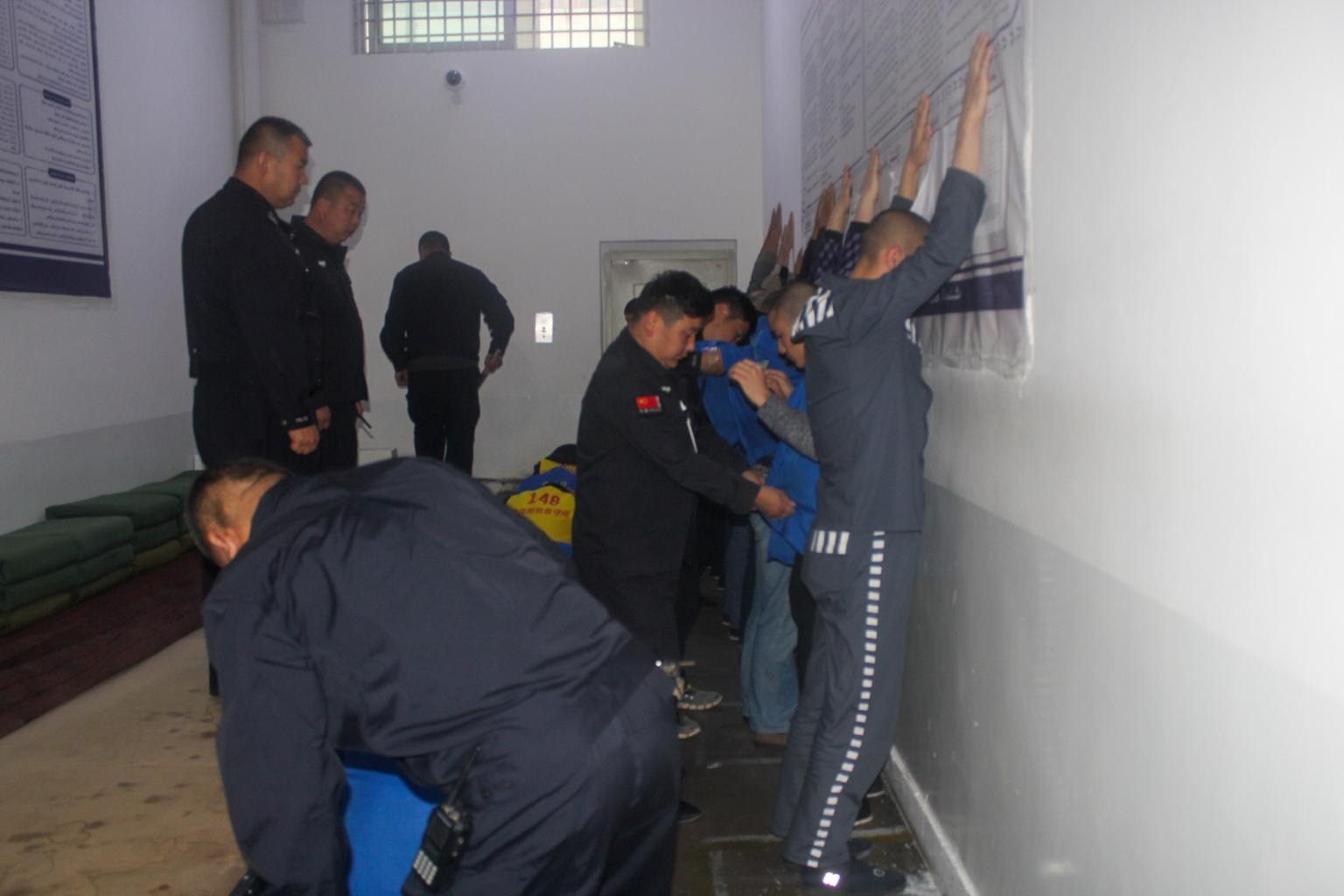
About 18 miles to the east of Tianyun’s headquarters is a pre-trial detention center in Nilka County known as kanshousuo. One of roughly 130 such centers, these facilities were widely renovated between 2017 and 2018. Older centers “were decommissioned and replaced with new buildings outside of population centers, normally two to ten times as large as their predecessors,” a 2025 report by the Simon-Skjodt Center for the Prevention of Genocide said.86 As of January 2025, the pretrial detention center in Nilka County could house nearly 400 detainees. A photo of the facility posted on the WeChat account of the local police shows a 2023 flag-raising ceremony. A group of about 20 police officers stood and saluted a Chinese flag in front of a four-story building with rows of barred windows. Across the front of the buildings, slogans written in bright red say: “Serve your country with your skills” and “There is hope for the people.” Gene Bunin, the creator of the Xinjiang Victims Database, said that most of the people in these centers have not committed clearly-defined crimes. Instead, they have more likely been flagged by the Integrated Joint Operation Platform (IJOP), which is the main surveillance and control app used throughout China but especially in Xinjiang.
Maya Wang, associate Asia director at Human Rights Watch, which in 2019 obtained and dissected a copy of the app, said that IJOP aggregates a vast array of personal data, identifying those people that its algorithms deem to be “untrustworthy.” The app draws on CCTV with facial recognition software, wifi sniffers that track movement and collect the unique identifying addresses of computers, smartphones, and other networked devices, as well as health, family planning, banking, and legal records.87 The app also tracks and marks as suspicious everyday, non-violent behavior such as not socializing with neighbors, often avoiding using the front door, the use of VPNs or WhatsApp, purchases of irregular amounts of gasoline, or when residents leave without police permission the area in which they are registered to live. Police visit people who have been flagged by the app, and if, after interviews, suspicions remain, the suspects are dispatched to pre-trial detention centers for further investigation.
Bunin said that pre-trial detention facilities tend to produce testimonies of the worst abuse likely because this is where police attempt to compile evidence to justify charges. Often, there is little legitimate evidence for the police to document, in which case they sometimes resort to torture or other means to elicit confessions, Bunin said. “The treatment in these facilities is so brutal that detainees often confess simply to get moved to a reeducation center or prison where the abuse is less,” he said.
Culturally, fish farming in Xinjiang is framed as a way to eliminate what officials describe as “idleness” and to mobilize “surplus labor” in a region long portrayed as economically stagnant.88 Without reshaping rural culture, disorder would persist in Xinjiang, Tang Renjian, head of the Ministry of Agriculture and Rural Affairs, warned in a 2021 article published on the ministry’s website. He argued that farmers left without structured work would spend their time gambling, holding lavish weddings and funerals, or engaging in “illegal religious and feudal superstitious activities.” He added: “If we do not occupy the ideological and cultural positions in rural areas,” he wrote, “they will be occupied by others.”


Seafood itself is not native to the region’s cuisine. In 2023, residents of Xinjiang consumed roughly six pounds of seafood per person—less than one-fifth of the national average.89 Traditional Uyghur seafood dishes, such as fish kebabs and fried fish—belik kawap and belik korumisi—are typically made with carp or herring. Most of the fish raised in Xinjiang is shipped to major cities in China’s east. Tianyun has cited local skepticism toward seafood as a barrier to expanding consumption closer to home. “Inland and rural areas have not yet formed habits of consuming aquatic products,” a 2022 article in Farmers Daily, reposted on Tianyun’s WeChat account, noted. By improving traceability and food-safety monitoring, the article argued, companies could build trust and “cultivate new consumption habits.”
According to the government, the deeper transformation driven by aquaculture in Xinjiang is socio-economic. Fish farming is neither the largest nor the most lucrative pillar of Beijing’s effort to remake the region, which has also involved extensive mining, fossil-fuel extraction, and industrial agriculture—particularly cotton, tomatoes, and renewable energy.90 But aquaculture stands out for the breadth of its ambitions, combining engineering, labor reorganization, and social management.
State Media Promotion
Local media boasts of how Tianyun has used innovative technology to create a fish farm in Xinjiang. Tianyun’s farm in Kalasu Township, Nileke County has deployed a digital chain supply tracing system to track each product “from breeding to the table,” according to a January 2024 article by Nileke County Media Center.91 “With the spirit of dedication, struggle, integrity, and innovation,” Tianyun “has built a complete industrial chain,” complete with “scientific and technological research and development, seedling breeding, smart aquaculture, processing, cold chain logistics, sales, and catering services,” wrote the company on a 2021 WeChat post.92 “At the same time,” it has “become the salmon farm farthest from the ocean in the world.” Tianyun uses AI and other technologies in its fish farming, including autonomous underwater robots, a “smart farming manager,” and a “full-link traceability system” for customers to scan a code and “trace the salmon from fry to table,” wrote the company in a 2025 WeChat post.93 “From fry hatching, breeding management, feed selection to fishing and processing, every link is strictly controlled and recorded,” Tianyun wrote.94 With a QR code, customers can identify the fishing and processing date, size, origin, and which cage the fish came from.”
Reporting in 2023 in the Chinese press about Tianyun described how the local government had initiated fish farming in the arid area. “Although Xinjiang has no ocean or seawater, it has saline-alkali land,” one article published by Xinjiang Net said in 2023.95 Local governments have broken the inertia of thinking and created an environment called ‘artificial ocean’ through innovative technology. On Yingbin Road in Urumqi, Xinjiang Pentium Biotechnology Co., Ltd. has prepared ‘artificial seawater’ suitable for the growth of marine organisms. Through fully enclosed industrial breeding, it has achieved local breeding of marine organisms such as giant tiger shrimp and salted tilapia.” The news article also mentioned a recent export of rainbow trout that had been exported to Thailand from Tianyun.96
Xinjiang Tianyun Salmon Fishery Co., Ltd.97 was among a number of companies visited by a delegation of cold water fish industry experts in October 2024, as reported by Xinhua, in an event to promote research and technical developments in the field.98 The visiting delegation included Cui He, president of the industry body China Aquatic Products Processing and Marketing Alliance (CAPPMA) and academics from Zhejiang University and the Chinese Academy of Fishery Sciences. In October 2023, CAPPMA posted commentary on the group’s website calling the Outlaw Ocean Project’s reporting on the use of forced labor in China’s seafood processing industry “a fabricated story” and “without any factual basis.”99
Tianyun’s chairman, Zhang Xiu, was recognized as a “National Model Worker” on April 28, 2025, along with about 1,600 other awardees throughout China. At the awards ceremony in Beijing, held in honor of the 100th anniversary of the All-China Federation of Trade Unions and attended by about 3,000 labor and party leaders, President Xi Jinping gave a speech in honor of the nation’s workers.100 In his speech, President Xi encouraged the audience to “promote the construction of a strong country” and “adapt to the new wave of scientific and technological revolution.” Afterwards, Zhang, one of about 50 honorees from Xinjiang, said “I will shoulder the responsibility and mission of developing and expanding my country’s salmon industry” and “lead more people of all ethnic groups to improve their knowledge, skills, and innovation capabilities.”101
China’s demand for seafood has increased as living standards improve, said the Ministry of Agriculture and Rural Affairs’ fisheries deputy director in a 2022 forum on aquaculture development, according to a WeChat article posted by Tianyun.102 Many seafood products have “changed from regional and seasonal consumption” to “national consumption and year-round consumption,” he said. These “growing needs have injected new impetus into the development of the industry.” However, there are still gaps in domestic seafood consumption, said a leader of the industry group China Aquatic Products Circulation and Processing Association. “In particular, inland and rural areas have not yet formed a habit of consuming aquatic products,” said a 2022 article written by Farmers Daily and posted to Tianyun’s WeChat account.103 But by establishing a “pond to table” tracing mechanism and improving food safety checks, companies will be able to enhance “customers’ trust in aquatic products” and encourage them to “cultivate new consumption habits.”
Tianyun received 15 million yuan ($2 million) from Jiangsu, a province on the eastern coast of China, through Jiangsu’s aid to Xinjiang program, according to a 2025 article on the website of the People’s Government of Xinjiang Uyghur Autonomous Region.104 Due to Tianyun’s “continuous expansion of production capacity” and demand for more labor, the “Jiangsu Aid to Ili” working group, referring to the prefecture where the company is located, arranged for the funds to be used to build new apartments for Tianyun’s workers. The apartments are expected to be completed by the end of June 2025, said Wang Pengjie, the administrative director of Tianyun. Tianyun will be able to “better guarantee the accommodation conditions for employees, and better produce food that consumers can trust.”
Road Ahead
In the past several years, a growing number of companies have tried to improve their supply chain tracing, partly to see what might be tied to state-sponsored forced labor in China. This is difficult because unannounced spot checks at factories, ships, or farms are effectively impossible. China is also a place where asking tough questions about Uyghurs, Tibetans, or human rights generally can get a company, civil society group, or journalist expelled.
China has also taken steps recently to make supply chain tracing even tougher. On August 5 2026, China announced that it had designated six US organizations primarily involved in supply chain due diligence and traceability under its counter-sanctions regime. The sanctions prohibit Chinese companies from cooperating with any of the listed companies. China described the sanctions as a response to recent US sanctions against Chinese companies accused of exploiting forced labor from Xinjiang.105 The threat of sanctions against companies involved in carrying out social audits could undermine how companies, both in China and abroad, are able to comply with anti-forced labor measures going forward, according to Kumi Consulting, a UK-based supply chain due diligence consultancy.106